8 min read
How to make a movie-style website gift worth sitting through
Chapters, episodes, a title card, credits that roll. The easy version is six chapter headings with almost nothing underneath them. That version reads worse than four plain paragraphs, because every heading is promising something the next screen does not deliver.
What goes inside a chapter before you name it
A chapter heading is a claim that something specific happened in it. Nine headings reading Beginnings, Growth, Distance, Forever and five more of the same are nine claims with nothing behind them, and the reader works that out by the second one.
So fill it before you name it. Write down the things that actually happened first — the lift that broke in June, the power cut, the wrong train, the bollard somebody reversed into at four miles an hour and then apologised to out loud — and then count how many chapters those add up to. It is usually four. It is almost never nine.
If you cannot write three sentences about what is inside a chapter, it is not a chapter. It is a title you liked the sound of.
Where to break the story into chapters
Break where something changed, not on the calendar. January to March, April to June is a filing system with the months doing all the work, and months are not what anybody remembers.
The breaks that hold up are the ones you can name out loud: the week before the move and the week after it, the two months of going quiet and calling it work, the spring you both stopped making plans.
Four to six is the working range, and the reel takes six shots at most. Test each break by swapping two chapters over in your head. If the page reads the same in either order, you had one chapter and cut it in half to fill the shape.
How to write episode titles that are not puns
Almost everybody reaches for the pun first. The Fault in Our Stairs. Eat, Pray, Argue. It buys one small breath of a laugh, and then the title has told the reader nothing, and the joke is about a film rather than about the two of you.
Flat beats clever nearly every time. The lift, June. Power cut. Wrong train. Sunday, four o’clock. Each one names a thing that happened, and the person reading already carries the whole story behind those three words, which is the only reason a title does any work.
The front of a reel shot takes twenty-eight characters, which is room for The lift, June and no room at all for a pun with a setup in it. The other test is whether one of you would say it out loud. Nobody has ever said Chapter Four: Growing Together. People do say the night of the power cut.
Deleted scenes need a reason, not just a title
A deleted scene only works if you say why it came out. A card reading "the argument in the car park" with nothing on the back of it is another title pretending to be a chapter. On the back of that one: forty minutes, both certain, neither listening, and the part where I was the problem.
Pick three or four that are genuinely awkward. The airport in March that nobody thought to film. The flat you looked at near their office in January and mentioned to nobody. Then write the honest reason on the back of each one — four or five sentences fit there, which is more room than the reason usually needs.
At least one should cost you something. A whole set cut for pacing reads like commentary about editing. The scene you cut because it makes you look bad, and then put back in anyway, is the one that gets reread.
The credits are where the sincere line goes
Credits arrive one line at a time with nothing else on the screen. Cold rice, once, in the dark gets a whole screen to itself, which four paragraphs saying the same thing would never get.
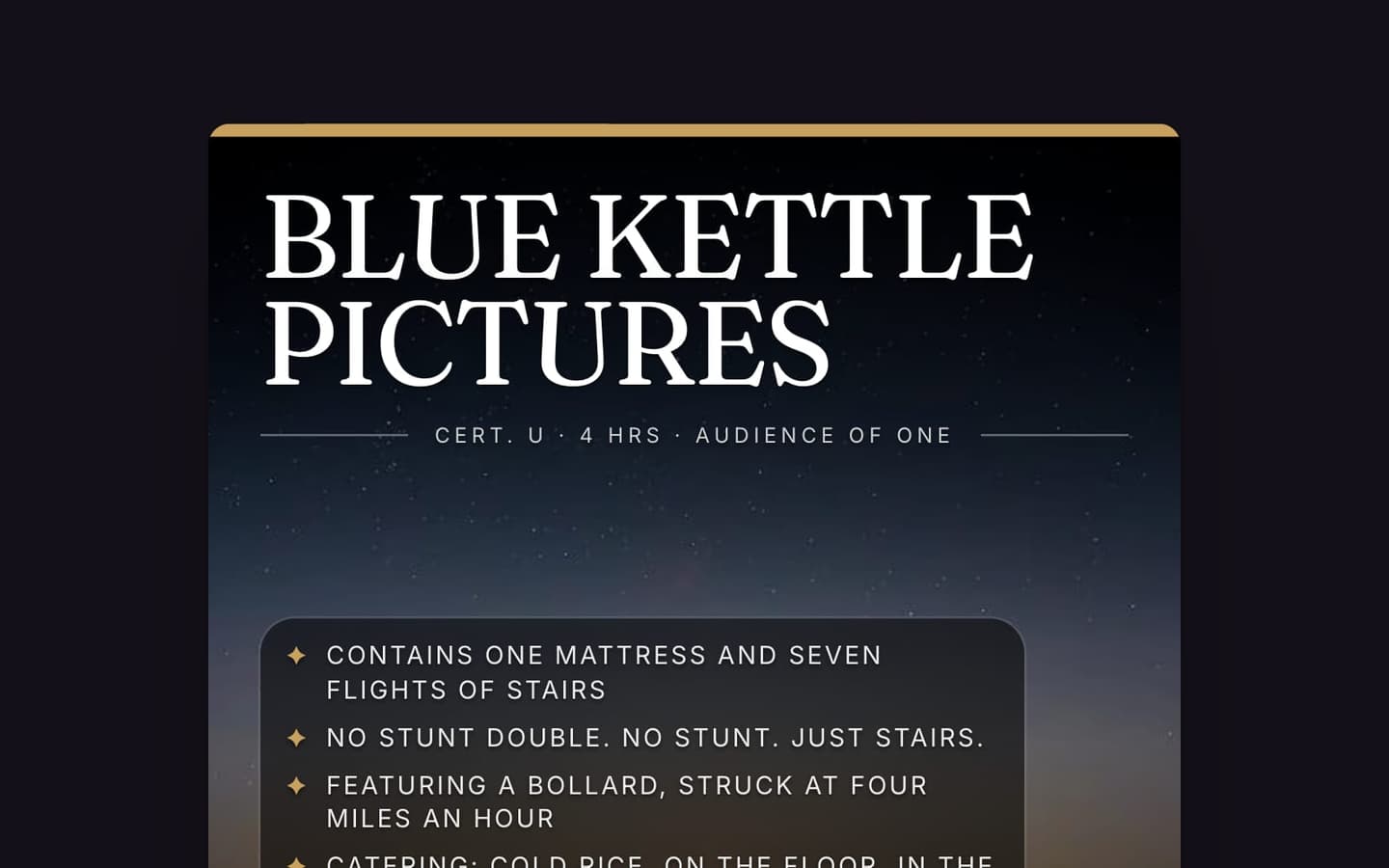
Build the list out of real jobs filled by the wrong people and objects. Catering: cold rice, once, in the dark. Transport: one wrong train. Continuity: none. Stunts: a mattress and seven flights of stairs. Grip: you, on the fifth landing, refusing to move. Twelve to fifteen short lines is plenty. By the fifteenth, the joke of Role: thing has been made twice already.
Then break the pattern once. After a dozen lines of Role: thing, a line with no colon in it lands like somebody switching the projector off and speaking in the dark. Put the sentence you have been avoiding there, and put nothing after it except your name.
Is a longer page a better page?
Two or three minutes of real reading beats twenty. The format invites a running time, and a page built to feel like four hours needs four hours of things that actually happened behind it, which almost nobody has written down.
If it does run long, use the intermission properly. Telling them plainly that the second half is the part you find harder to say makes them sit down for it instead of reading on at the same speed.
Point at something outside the film as well. A countdown to the next date you are in the same room, gate number and all, takes the page out of the format and puts it back into the week they are having. If you use one, use a date that exists.
Why the streaming-service joke wears off
The first instinct is parody: the red logo, a row of fake show tiles, Top 10 in your household today. It is funny once, and then it is a page about a company.
It also ages badly. When the service redesigns its interface, and it will, the joke stops reading as a joke and starts reading as an old screenshot of something else.
Borrow the grammar rather than the branding. A title card, chapters, an intermission, credits — none of that belongs to anyone in particular. A page that looks handmade, all projector dust and splices that show, cannot be dated by another company’s design team.
The same thing, written badly and written well
Chapter One: The Beginning
The lift, June
Episode 3 — Love Actually, Us Actually
Power cut, cold rice
Directed by: Fate. Produced by: Destiny.
Catering: cold rice, once, by torchlight. Continuity: none.
Now streaming: the greatest love story ever told.
Four hours, one viewer. Sit near the middle, the sound is better there.
Deleted scene: the fight. We do not talk about that one.
Deleted scene: forty minutes in a car park, both certain, neither listening. Cut, then put back, because I was the problem in it.
Thank you for watching.
You stayed through the slow parts. Those were the parts I meant.
Questions people ask about this
how many chapters should a movie-style gift page have
Four to six. Fewer than four and the chapter format is doing nothing that ordinary paragraphs would not do. More than six and you begin inventing breaks to fill the shape, which is where these pages go thin. Write down the things that genuinely happened first, then count how many chapters that material makes. The number should come out of the content.
what should i call the chapters on a film-style gift website
Name each chapter after the thing that happened, as flatly as you can. The lift, June. Power cut. Wrong train. Sunday, four o’clock. A flat title works because the person reading already carries the story behind it, so it lands the instant they see it. Puns on film titles earn one small laugh and then say nothing about what is inside.
what do you write in the end credits of a personalised gift page
Write real film jobs filled by the wrong people and objects. Catering: cold rice, once, in the dark. Transport: one wrong train. Continuity: none. Stunts: a mattress and seven flights of stairs. Keep it to about fifteen short lines, then break the pattern with one plain sincere sentence at the end, and sign it.
should a gift website look like netflix
No. A parody of a streaming service is funny once, after which the page belongs to a company rather than to the two of you, and it dates the moment that company changes its interface. Take the film grammar instead — a title card, chapters, an intermission, credits — and let the look be handmade rather than borrowed.
how long should a cinematic gift page be
Two to three minutes of actual reading suits most of these. The format tempts people into a full running time, but every extra chapter has to be paid for with something that really happened. If it does run longer, use the intermission to say plainly that the second half is the part you find harder to say.
can you make a movie-style page for a friend or a birthday
Yes. Chapters, episode titles and credits fit anything with a sequence to it — fifteen years of a friendship, a birthday, a year that was harder than most people realised. The credits list suits a friend particularly well, because it lets you be funny for twelve lines and then sincere on the thirteenth without any warning.
what photos work best on a film-themed gift page
Stills rather than portraits. The frames nobody meant to keep — half a face, a kitchen at two in the morning, someone asleep on a train — read as footage, while posed and flattering shots read as a slideshow. Save the writing for the six on the reel, where a line goes on the back of each one. Six of those carry more than twelve nobody has written anything about.
If you are stuck
Answer one of these honestly and you will have the sentence the page needs.
- 01Which six months changed how the two of you actually live day to day?
- 02What is the flattest possible way to describe the best night you had together?
- 03Which scene did you leave out, and what is the real reason it came out?
- 04What job has that person been doing the whole time that nobody has ever credited them for?
- 05What would honestly be printed on the poster: certificate, running time, and one line about what is in it?
- 06What is the sentence you want them reading when the credits have stopped moving?