7 min read
How to send a missing you page without making it heavy
Nothing is wrong, nothing has happened, and there is no date asking for this. That is the whole difficulty. With no occasion holding it up, the page has to be held up by one small thing that actually happened to you today.

Why "I miss you" on its own lands flat
Three words that describe your state and give the reader nothing to picture. They already know you miss them. What they do not know is that you made two coffees this morning before leaving the flat, and that the second one was still on the counter, cold, when you got home.
The three words also arrive as a mood. Send them at half past eleven and they have to work out what you want back, which is usually the same three words returned. A cold second coffee on the counter asks for nothing. It is one morning, handed over, and they can do what they like with it.
So write the evidence and let the three words be the conclusion they reach on their own. If you want the words on the page, put them once, late, after the reader has already been shown why.
Picking the one small thing that carries the whole page
The detail has to pass three tests. It happened, recently and actually. It has an object in it you could point at — a second cup, a spare key, the plate you still get down for two. And they will recognise it as theirs rather than as a nice line about absence.
Skip the greatest hits. The holiday, the airport, the night everyone tells the story about — those belong to both of you and to everyone else who was there. The noise they make in the next room while looking for something they are standing next to belongs only to you, and that is the one worth writing.
One object is enough for the whole thing. Open with it, come back to it in the letter, and let the last line return to it: the second cup poured away tonight and made again tomorrow morning. Eleven things you miss reads as a list. One thing followed all the way through reads as a Tuesday.
Sending it at a time that suits their day, not your 2am
These get written late, and that part is fine — one in the morning is when the sentence you have been avoiding all day finally turns up. Sending at one in the morning is a different matter. They wake to it, answer half asleep, and the first thing it has done is take something from them.
Write at the bad hour, then sit on it. Send it into a dull, unwatched stretch of their day: mid-morning once the first meeting is over, the flat half hour after lunch, the train home. The half hour after lunch has nothing else in it. Nobody reads properly at 9:05 with a call about to start.
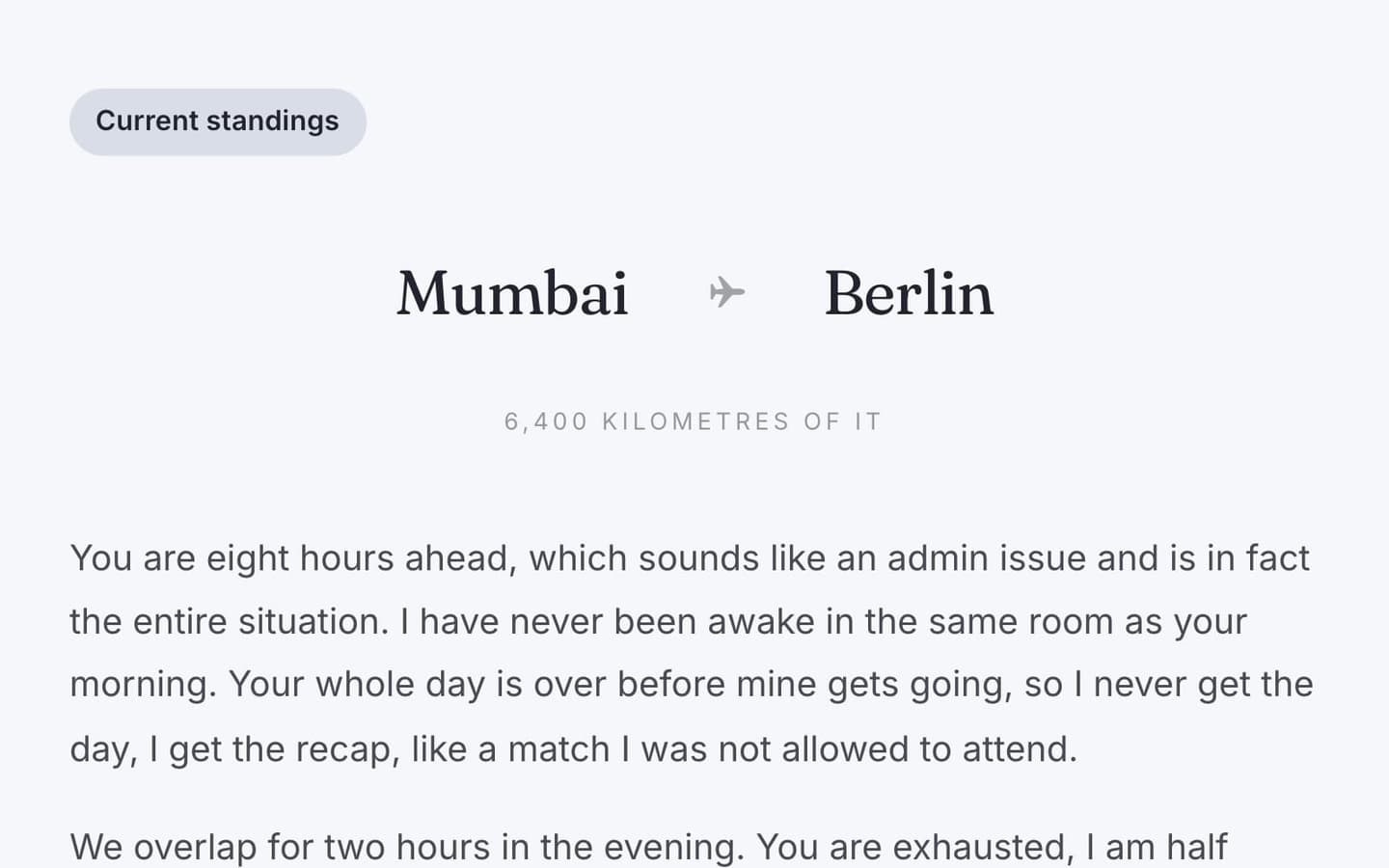
If they are in another city or another country, work out what your send time is at their end before you press anything. Landing in their morning gives them the whole day to come back to it. Landing eleven minutes before they sleep gives them a choice between staying up and feeling bad about not staying up.
How do you make it clear you want nothing back?
Take the questions out. Anything ending with "so when are you free to talk" or "do you miss me too" has turned into a request, and they will feel the shape of it even while answering warmly. Statements only. The last line should be somewhere to stop, not a door held open.
Say it once, plainly, somewhere in the middle: there is nothing to answer and nothing to send back. Then behave that way. Do not message two hours later asking whether they have opened it. If it took you an evening to write, give them two days to get to it.
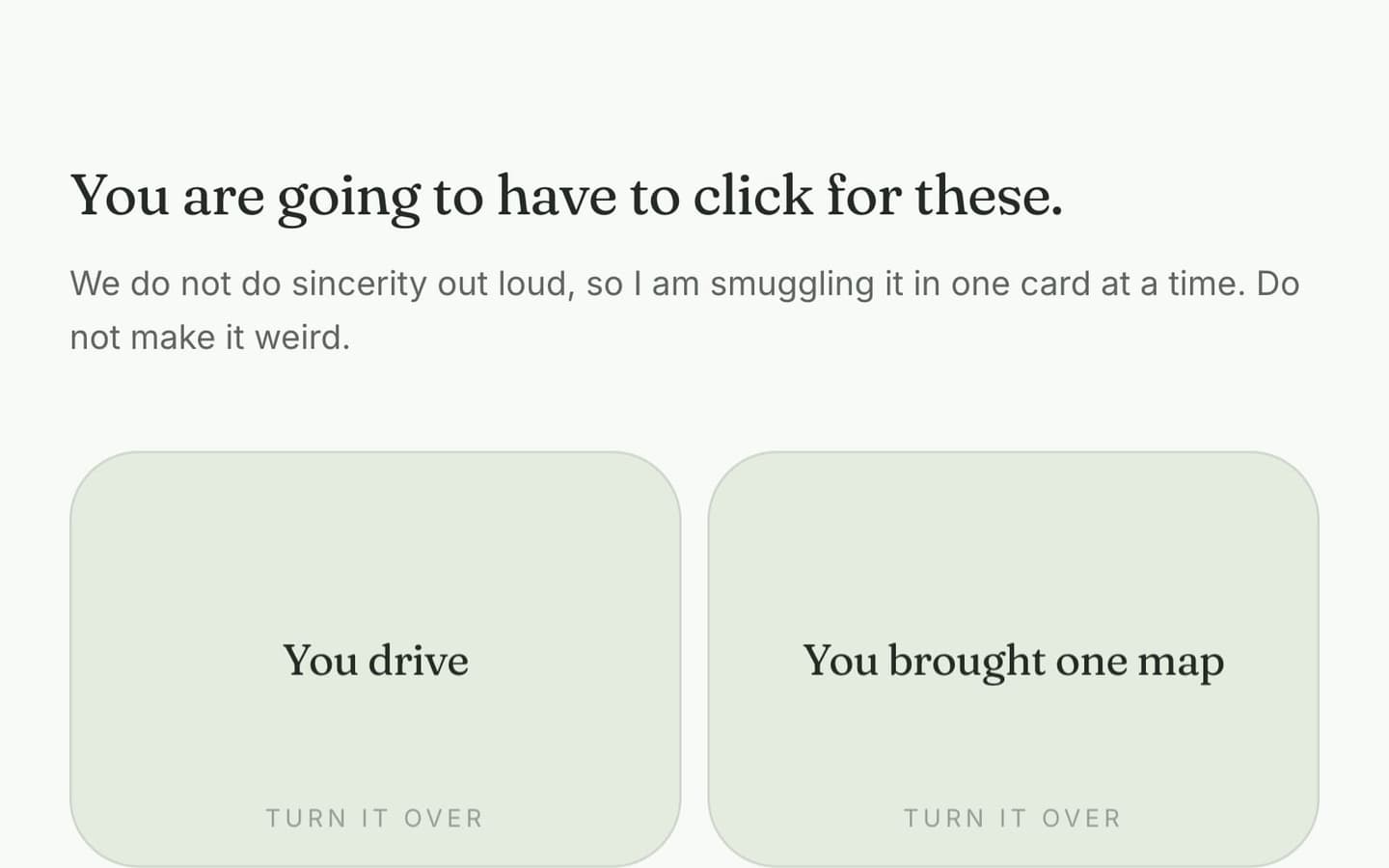
Watch the labels on anything sealed. "Open when you are having a long week" is for them. "Open when you miss me too" is for you, and it is an instruction wearing a gift label. The missing you template starts you with four of these labels: three name an hour of theirs, the long week and the late night still awake among them, and one — "you also made two of something this week" — is a hope of yours. Rewrite that one before you send it.
What goes on a page when there is no occasion to hang it on
A birthday supplies its own order. Here there is none, so the small event has to hold the structure together: what happened this morning at the top, the writing in the middle explaining why it did anything to you, and a last line that puts you back in the kitchen with the cold cup. The long distance template gives that job to a countdown to the next time you are in the same room, so if you build on that one and there is no date yet, switch the countdown off and let the morning carry it.
In between, report the week rather than the relationship. Three things from the last seven days, none of them important — the thing at work they would have found funnier than it was, the nine minutes of rain, the phone picked up and put down again because of the hour where they are. The rain is news. "I have been thinking about you a lot" is not.
Photographs work best here when none are recent. Choose the ones where they are in a room you were also in, and write what was happening rather than when. If you use a number of days since you last saw them, admit you counted once, tonight, and leave it there. A number you check every morning stops being missing them and starts being a score.
When does a missing you page tip into too much?
At the point where it stops being about a second cup and starts asking them to do something. "I cannot do this without you" and "please come home" are real sentences with a real place, and that place is a conversation where they can answer in the same minute. Here they land on somebody who cannot reply for another six hours.
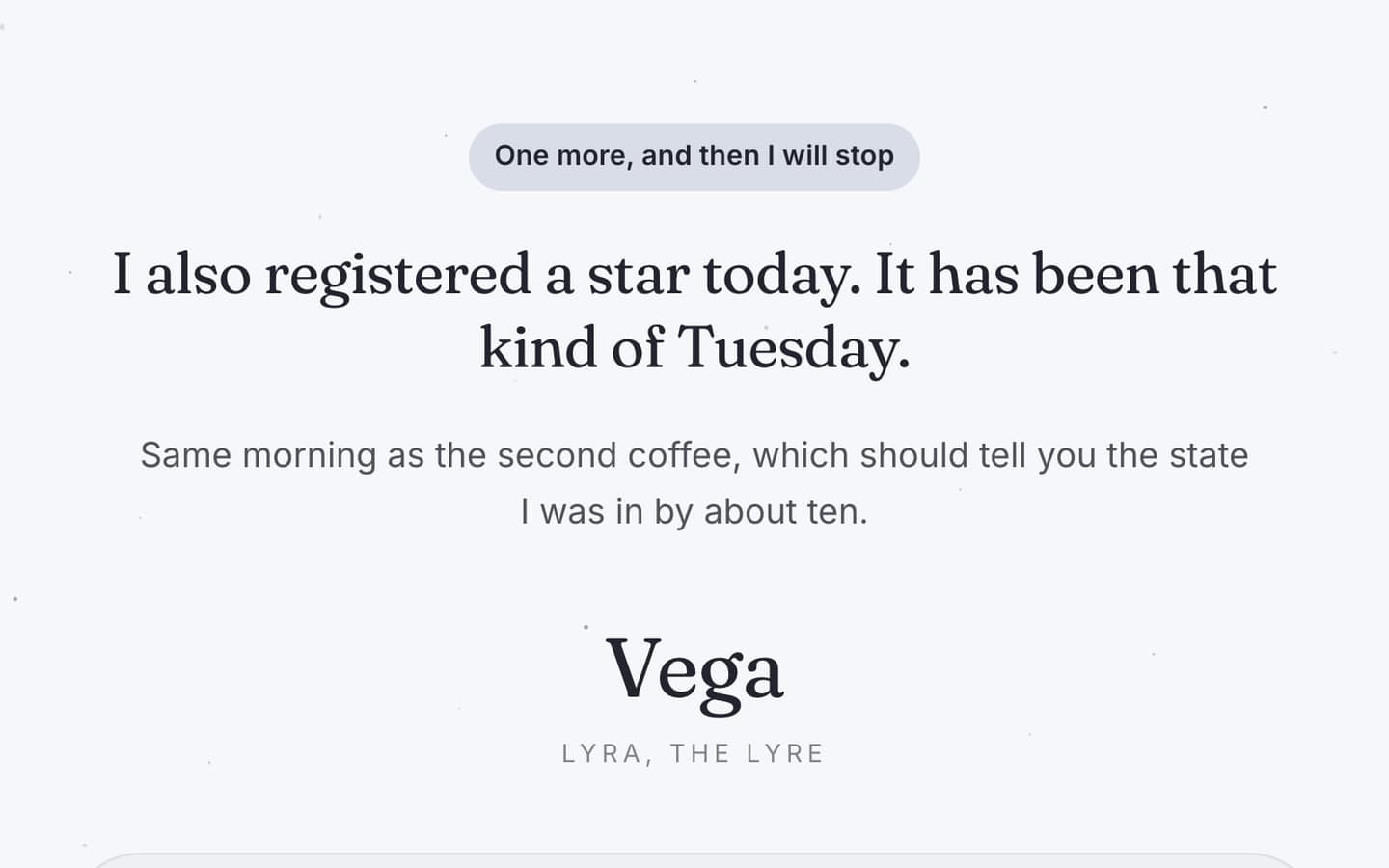
Length is the other tell. The missing you template opens with sixteen scenes and a letter of five short paragraphs, and most of the weight comes from filling in scenes you have nothing specific for. Switch off the ones you would only be padding — the toast, the song, the star — and keep the letter to about the five it starts you with. Ten scenes somebody can get through on the train home beats sixteen that are half filled in.
And if what is actually going on is a problem between you — a run of bad calls, a decision neither of you has made — do not send this instead of raising it. Send it afterwards. A grievance buried in something built out of missing them will be the only part they read.
The same thing, written badly and written well
I miss you so much it hurts.
I made two coffees again this morning. The second one was still on the counter, cold, when I got home.
Life is just not the same without you here.
I keep hearing you looking for your keys in the next room. There is nobody in the next room.
You have no idea how much I think about you every single day.
I thought about your laugh four times today and only turned round once.
When are you finally going to come and see me?
There is nothing here to answer. Come when it is easy, and not before.
Wish you were here with me right now.
I ordered for two at the usual place out of habit, and the waiter noticed before I did.
Questions people ask about this
what do you write when you miss someone but there is no occasion
Write what actually happened today rather than how you feel in general. A stranger laughed like them in a café; you made two coffees out of habit; you picked up the phone and remembered the hour where they are. One small event with an object in it does far more than a paragraph about missing them, because they can picture it.
is it weird to send someone a gift page for no reason
No, and having no reason is exactly what makes it land. Anything sent on a birthday was partly produced by the date. Something sent on an ordinary Tuesday could only have come from you thinking about them on an ordinary Tuesday. Keep it small and ask for nothing back, and it reads as sincerity rather than as a hint at something.
how do you say i miss you without sounding needy
Report a detail instead of making a request. The question at the end is what makes it needy, not the missing: "do you miss me too" is a request, and a cold second coffee on the counter is not. Say the small true thing, say once that there is nothing to answer, and then leave it alone for a couple of days instead of following up.
when is the best time to send a missing you message
Send it into a quiet, ordinary part of their day rather than yours. Mid-morning after their first meeting, the flat half hour after lunch, or the train home all leave room to read it properly. Avoid late nights at their end, and if they are in another time zone, work out what your send time is where they are.
how long should a missing you page be
Short enough to read in one sitting on a phone. One opening event, three or four small things from the week, and a letter of about five short paragraphs is plenty, which is the length the missing you template already starts you with. Past that, the length itself begins to ask for a matching response, so switch off any scene you would only be padding out.
can you send a missing you page to a friend or family member
Yes, though which template you start from matters. The missing you and long distance ones are seeded as partner copy, down to the other side of the bed, so for a sibling or an old friend start from the just because template, which is written for friends and family. Keep the ordinary news and the bad old photographs, and drop the romantic framing.
what if they do not reply to it
No reply means the missing you page did its job, because you wrote it to need none. Silence for a day or two is not an answer and not a verdict. Do not send a follow-up asking whether they saw it. If the link is still unopened after several days, mention it once, lightly, and then drop it.
should you say how many days it has been since you saw them
Only if you are honest about how you know it. A number you clearly track every day changes the tone from missing them to keeping score. Say that you had not counted until tonight, that you counted once, and that you slightly wish you had not. Used once it is a good line. Used as the spine of the page it is heavy.
If you are stuck
Answer one of these honestly and you will have the sentence the page needs.
- 01What happened today, specifically, that made you think of them?
- 02Which object in your flat is currently doing the missing for you?
- 03What noise do you still expect from the next room and no longer hear?
- 04What did you nearly ring them about this week and then not ring about?
- 05Which is the dullest hour of their day, and what would you want them to open in it?
- 06What have you stopped telling them because the call is always too short?